



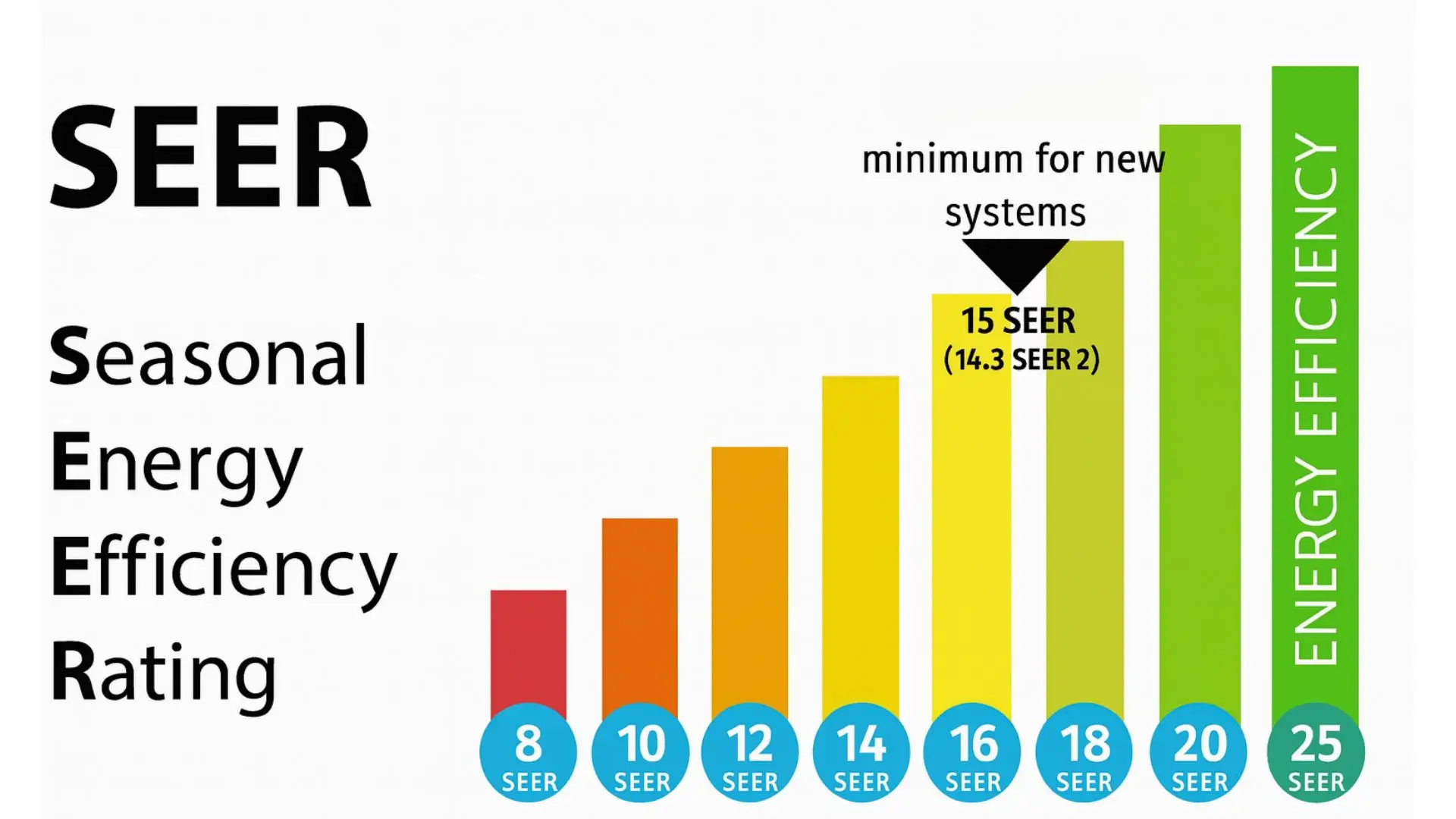


When buying an air conditioner or heat pump, efficiency rating is one of the most important factors. Earlier, SEER (Seasonal Energy Efficiency Ratio) was the standard benchmark. But from January 2023, the U.S. Department of Energy introduced SEER2, a more realistic and updated measurement standard.
Many homeowners today search for — What’s the difference between SEER and SEER2? Which one is better for my home? Does SEER2 save more electricity?
This guide covers everything clearly with real comparisons, examples, and FAQs.
What is SEER Rating?
SEER (Seasonal Energy Efficiency Ratio) tells how efficient an air conditioner is at cooling during a regular summer season.
The higher the SEER value, the less electricity the system needs to produce the same amount of cooling.
Formula:
SEER = Cooling Output ÷ Energy Used
Simple Way:
If two ACs produce equal cooling, the one with higher SEER will consume less power.
However, SEER is tested under ideal lab conditions, not the way systems actually run inside homes with duct bends, air filters, and pressure resistance. Learn more about AC SEER ratings to understand how efficiency is measured.
What is SEER2 Rating?
SEER2 is the newer version of SEER.
It measures efficiency using stricter testing that simulates real home conditions, where airflow faces resistance through ducts and filters.
It uses the M1 test method, which increases external pressure nearly 5 times more than the SEER test — making results more realistic. Want to know how SEER2 ratings affect the cost of air conditioners? Here’s a detailed comparison of standard vs high-efficiency systems.
Simple explanation:
- SEER shows efficiency on paper (lab conditions)
- SEER2 shows efficiency in real world usage (actual home conditions)
SEER vs SEER2 – Core Differences
Testing Method:
- SEER: M test (older standard)
- SEER2: M1 test (stricter, more realistic)
External Static Pressure:
- SEER: Low
- SEER2: ~5x higher, simulates real ducts
Real-World Accuracy:
- SEER: Moderate
- SEER2: High
Regulation Status:
- SEER: Pre-2023 standard
- SEER2: Mandatory for new units (2023+)
Minimum Efficiency Requirement:
- SEER: Higher on paper
- SEER2: Slightly lower numeric value, but more realistic
Energy Savings:
- SEER: Good
- SEER2: Better long-term savings
Cost of Units:
- SEER: Usually cheaper upfront
- SEER2: Slightly higher upfront cost
Suitability:
- SEER: Older calculations, legacy comparison
- SEER2: Current industry standard, accurate for modern units
SEER to SEER2: Understanding the Conversion
When switching from SEER to SEER2, the testing method became stricter.
Key point: The same AC unit may show a slightly lower SEER2 rating, but its actual efficiency does not decrease — only the rating calculation has changed.
Think of it like exam grading:
- Old exam: Easier → Higher scores (SEER)
- New exam: Harder → Slightly lower scores (SEER2)
- Student: Same performance → Just the test changed
SEER to SEER2 Conversion (List Version)
1. 14 SEER → ~13.4 SEER2
Same efficiency, rating looks lower
2. 15 SEER → ~14.3 SEER2
Machine unchanged, testing stricter
3. 16 SEER → ~15.2 SEER2
Performance same, number slightly lower
Tip: SEER2 ratings are usually 0.5–1 point lower than SEER for the same unit because testing is more realistic.
Practical Example
If you bought an AC in 2021 labeled 16 SEER, and the same model is re-tested under SEER2 rules in 2023, its rating might show ~15.2 SEER2.
Does the AC perform worse?
No — the performance is the same. Only the measuring scale is stricter.
Which SEER2 Rating Should You Choose?
Since 2023, almost all new HVAC models are rated with SEER2, which is now the standard for realistic efficiency. Choosing the right rating depends on budget, climate, and usage. Planning an upgrade? See the best time to buy an HVAC system for maximum savings and efficiency.
Here’s a practical guide:
- Tighter budget (13–15 SEER2): These units are more affordable upfront. They still provide decent cooling, but may use slightly more electricity in the long run. Ideal if you plan to stay in your home short-term or want to save on initial cost.
- Better long-term savings (16+ SEER2): Higher-rated units consume less electricity for the same cooling. Over time, the lower energy bills can offset the higher upfront cost. Perfect for homeowners who plan to stay for several years.
- Hot climates or heavy usage: If your AC runs many hours a day, or summers are extremely hot, choosing a higher SEER2 rating ensures better performance, more consistent cooling, and lower electricity bills.
- Rental or short-stay properties: Mid-range SEER2 units (14–15) are usually enough. They balance cost and efficiency without over-investing in long-term energy savings that won’t pay off.
Rule of thumb: Higher SEER2 = Lower electricity costs + Better comfort over time.
Cost & Savings
- Standard System (14 SEER2): ~$700/year
- High Efficiency System (18 SEER2): ~$520/year
Approx savings: $180/year
Over 5 years → $900–$1200+ depending on usage and climate.
Takeaway: Higher efficiency units recover cost over time through lower electricity bills.
Pros & Cons About SEER & SEER2
Why choose SEER?
- Easy to recognize — many people are familiar with it
- Usually cheaper to buy
Limitations of SEER:
- Doesn’t show real efficiency in a home
- Might make savings look better than they actually are
Why choose SEER2?
- Shows how your AC really performs at home
- Tested more strictly → gives accurate efficiency
- Can save more money on electricity over time
Limitations of SEER2:
- Costs a bit more upfront
- Rating numbers look lower than SEER, but performance is the same
Considering a premium brand for your home? Check if Trane AC units are a good choice in Las Vegas
before making your purchase.
Frequently Asked Questions
1. Is SEER still used?
Yes, but SEER2 is now the primary rating for new equipment.
2. Which is better — SEER or SEER2?
SEER2 is more accurate. For new HVAC systems, always compare SEER2 ratings.
3. Does higher SEER2 reduce electricity bills?
Yes. Higher SEER2 = better efficiency = lower running cost.
4. What is a good SEER2 value for homes?
14–18 SEER2 is standard. 18+ SEER2 is premium high-efficiency.
5. Can we compare SEER with SEER2 directly?
Not exactly. SEER2 value will be slightly lower even if performance is equal.
Conclusion
SEER and SEER2 both measure HVAC efficiency, but SEER2 is more accurate, realistic, and aligned with modern energy standards.
If you are planning to buy or upgrade an AC/heat pump, always compare SEER2 ratings first. Even though higher efficiency units may cost a bit more initially, they save more money long-term through reduced energy consumption.


