





Indoor humidity control in Las Vegas presents a distinct challenge. With consistently low outdoor humidity levels, most residential HVAC systems circulate excessively dry air throughout the home. Over time, this affects occupant comfort, respiratory health, and interior materials such as wood flooring and furniture.
For homeowners considering a whole house humidifier, the decision typically comes down to two options: bypass or fan-powered. While both systems are widely used, their performance differs significantly in desert climates.
This guide provides a clear, experience-driven evaluation to help you select the right system for long-term performance, not just initial cost.
Understanding Whole House Humidification in Dry Climates
A whole house humidifier integrates directly with your HVAC system to regulate indoor humidity levels. In a climate like Las Vegas, where relative humidity often remains well below comfort thresholds, the system must compensate for continuous moisture loss.
Unlike portable units, a properly installed whole house system:
- Delivers uniform humidity across all conditioned spaces
- Operates automatically with the HVAC system
- Maintains stable indoor conditions without constant user input
In this environment, system capacity and consistency are more important than basic functionality.
System Overview: Bypass vs Fan-Powered
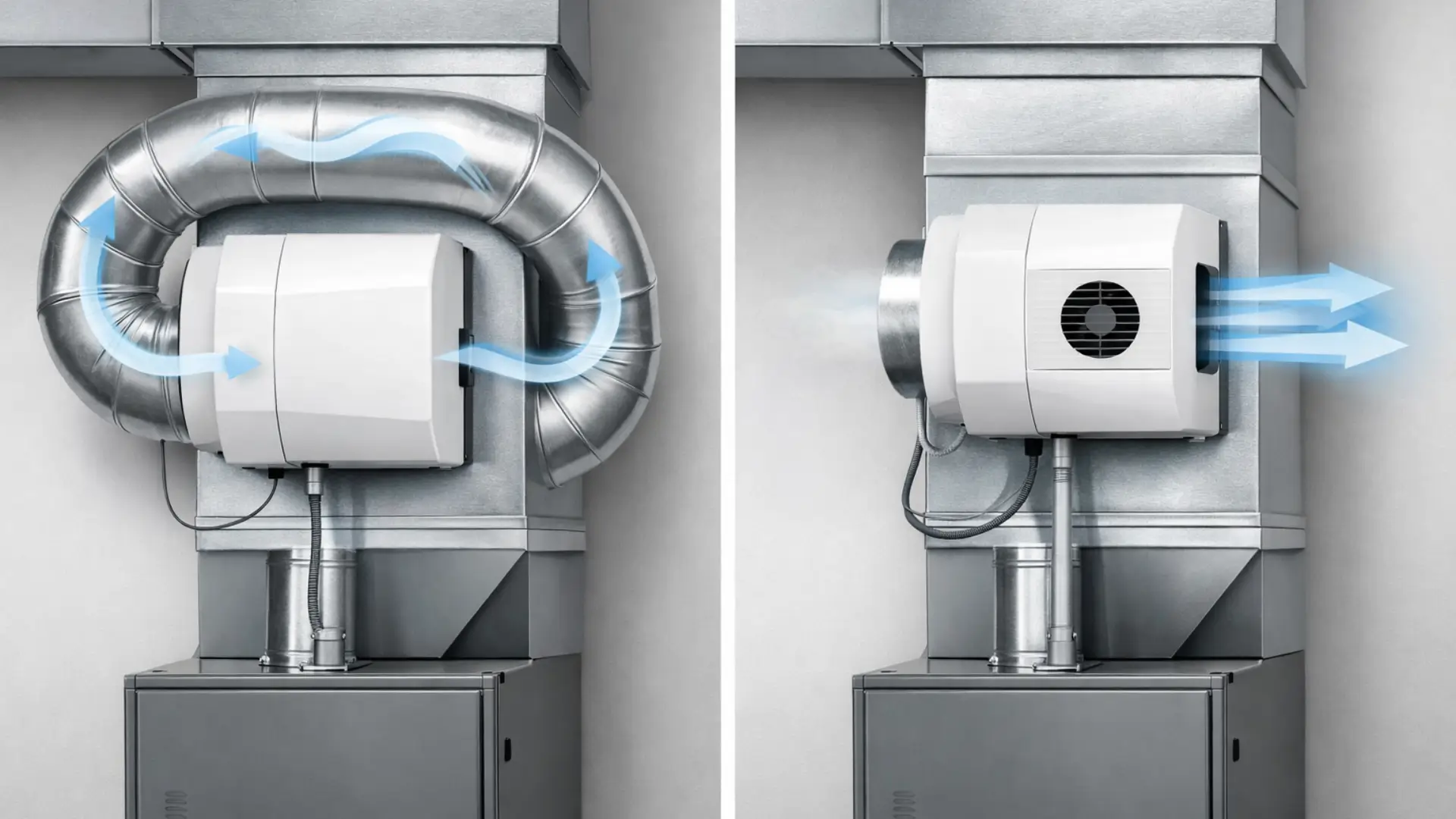
Both bypass and fan-powered humidifiers use an evaporative process, where air passes through a water-saturated panel to absorb moisture. The distinction lies in how airflow is generated.
- Bypass humidifier: Relies on the furnace blower and duct pressure differential
- Fan-powered humidifier: Uses an internal fan to actively move air through the unit
This difference directly impacts output capacity, operational consistency, and suitability for arid conditions.
1. Bypass Humidifier: Design and Performance
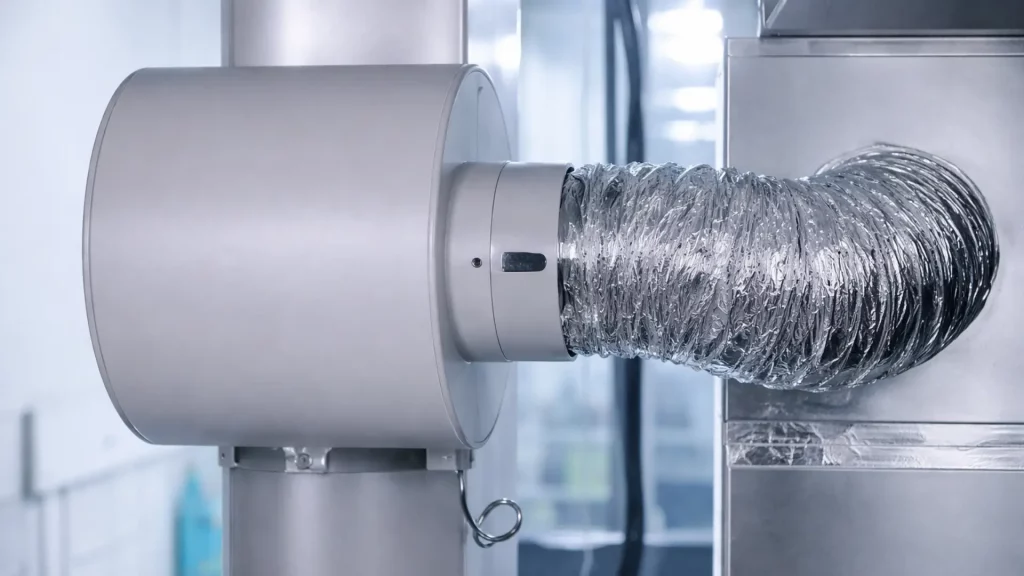
A bypass humidifier is installed between the supply and return ducts. It uses a bypass duct to redirect a portion of heated air through the humidifier panel.
Performance Characteristics:
- Dependent on furnace operation for airflow
- Lower evaporation rate due to passive air movement
- Reduced output during partial load or mild weather conditions
Practical Limitations in Las Vegas:
In field applications, bypass systems often underperform in desert environments for the following reasons:
- Limited runtime dependency: During periods of low heating demand, humidity delivery drops significantly
- Lower capacity: The system struggles to raise humidity levels in larger or open-plan homes
- Delayed response: It takes longer to achieve target humidity levels
Appropriate Use Cases
A bypass humidifier may be suitable when:
- The home is small to average in size
- Budget constraints are a primary concern
- The homeowner accepts moderate humidity improvement rather than precise control
2. Fan-Powered Humidifier: Design and Performance
A fan-powered humidifier incorporates an internal blower that actively draws air through the water panel, independent of duct pressure conditions.
Performance Characteristics:
- Higher and more consistent airflow across the evaporative surface
- Increased moisture output per cycle
- Reduced dependence on furnace runtime
Advantages in Desert Conditions:
From a professional standpoint, fan-powered systems are better aligned with the demands of Las Vegas homes:
- Consistent humidity delivery: Maintains output even during variable HVAC cycles
- Higher capacity: Capable of serving larger homes and open layouts
- Faster recovery time: Reaches desired humidity levels more efficiently
Considerations:
- Higher initial installation cost
- Slightly increased electrical consumption due to the internal fan
Comparative Analysis
The following table summarizes the key performance differences:
| Parameter | Bypass Humidifier | Fan-Powered Humidifier |
|---|---|---|
| Airflow Mechanism | Passive (furnace dependent) | Active (internal fan) |
| Moisture Output | Moderate | High |
| Climate Suitability | Moderate climates | Dry and arid climates |
| Performance Consistency | Variable | Stable |
| Installation Cost | Lower | Higher |
| Application Range | Small to mid-sized homes | Mid to large homes |
Cost Considerations: Initial vs Lifecycle Value
A common mistake in system selection is prioritizing upfront cost over long-term performance.
Initial Investment:
- Bypass systems generally have lower installation costs
- Fan-powered systems require a higher upfront investment
Operational Perspective:
In Las Vegas conditions:
- A lower-cost system that fails to meet humidity requirements often results in dissatisfaction
- Retrofitting or upgrading later increases total expenditure
From a lifecycle cost perspective, selecting a system that aligns with environmental demand is the more economical decision.
Professional Recommendation
Based on installation experience and long-term performance observations in Las Vegas:
- Bypass humidifiers provide a cost-effective but limited solution
- Fan-powered humidifiers offer superior performance, consistency, and scalability
For most residential applications in this region, a fan-powered humidifier is the more appropriate choice.
Conclusion
Selecting the right humidification system in Las Vegas requires more than a basic feature comparison. The local climate demands consistent, high-capacity performance that many entry-level systems cannot deliver.
While bypass humidifiers may be adequate in controlled scenarios, fan-powered systems are better suited to meet the expectations of homeowners seeking reliable indoor comfort.
A well-informed decision at the installation stage prevents performance issues and additional costs in the future.